reading and writing support
OUR TEACHING APPROACHABOUT OUR APPROACH
Sound Connections focuses on building reading, writing, and spelling skills from the foundational level. We follow a research-based, multi-sensory, highly explicit, and systematic instructional approach to learning. Many students come to Sound Connections struggling to maintain age-appropriate skills, which are often caused by gaps in their literacy skills from earlier years. After screening each child, an individualized program is designed to assist the child with all aspects of literacy and strengthen weaker areas that may be causing their delays. We ensure that the lower-level foundational skills are strong enough to support the higher skills. Following this we cumulatively build with consistent review and overlearning. Ideally, in grades 3 to 4, children shift from learning to read to reading to learn, which is why early intervention is so vital. Researchers stress the importance of early intervention for struggling readers and writers to lessen the impact of later literacy issues. Strong literacy skills are crucial across all subjects and continue well into adulthood. Therefore, we believe establishing strong literacy skills early in life will set children up for success in their future.
WRITING
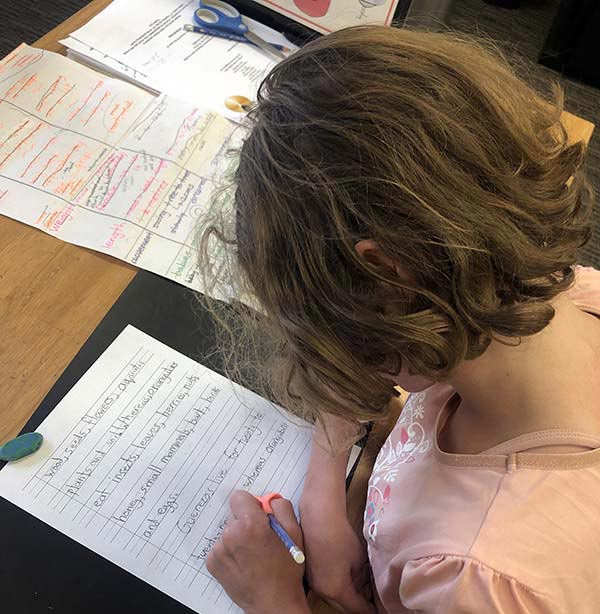
Sound Connections ensures lower-level writing skills are automatic and fluent so that the student can focus their cognitive resources on higher-order aspects of writing necessary to create quality written work. Sound Connections develops conventionally correct printing patterns for writing skills, transitioning from the individual letter, into the single word, and onto the simple patterned sentence, ensuring a structured and bottom-up approach. Following this, we focus on using transitional language and the elaboration of sentences. Appropriate grammar and writing mechanics are taught to the level of automaticity, ensuring that the child can apply these skills without effort. Once the sentence level is mastered, we work on a simple paragraph structure. Eventually, these skills generalize into learning more advanced essay structures. A full range of literary devices are taught through structured tasks. This includes onomatopoeia, similes, metaphors, alliteration etc. We also focus on on writing goals for different purposes such as descriptive, instructive, narrative, and persuasive tasks. Vocabulary development is incorporated into all sessions to improve creative writing and enhance both oral and written language skills. It is important that, at this stage, writing topics are interest driven and motivational to the learner. Children are encouraged to take risks and develop confidence in writing.
SPELLING
Spelling is taught through multi-sensory activities and is further generalized into sentences and advanced writing tasks. We incorporate structured teaching of common orthographic patterns (e.g., ea, igh, ar, or, ou, ow etc.) and rules, sound to spelling patterns, rhyme and onset-rime units, syllables and syllable division patterns, phonics, and practical ‘brain-tricks’ for classroom survival. Sound Connections teaches the most frequently used spelling words first, ensuring that the most useful words are accessible and functional for the classroom. A large amount of over-learning is required to ensure spellings are automatic. This frees up intellectual capacity for higher-level writing tasks. Basic understanding of morphology is also developed (i.e., word parts that carry meaning such as roots, prefixes, and suffixes). This supports the child with their spelling ability while also teaching strategies for defining words they may not have known before.

PHONOLOGICAL AWARENESS
Phonological awareness refers to an explicit awareness of the sound structure of language, and the ability to manipulate different units of sound. Phonological awareness includes different levels, such as the awareness that sentences are made of individual words. These individual words are made of syllables. Within syllables, there are smaller units of sound, such as the onset and the rime unit (e.g. cat segmented into “c…at”). Finally, the ultimate goal is for our students to blend, segment, and manipulate the phoneme, which is the individual sound. Multiple long-term studies have found that phonological awareness skills are critically important for both reading and spelling. Phonological awareness skills are taught explicitly into both reading and spelling development through phoneme-grapheme mapping and metacognitive teaching. Children are taught to be aware of strategies that help themselves as learners.
READING
Reading is taught using a research-based structured approach. Sound Connections incorporates phonological awareness, phonemic awareness, phonics skills, and high-frequency sight words into our reading programs. Skills are built from a firm foundation, ensuring the child has automaticity in their phonological awareness skills, alongside a correct and accurate alphabetic principle. Our sight word program is taught through multi-sensory modalities, rather than rote memorization and is developed alongside phonological awareness, phonemic awareness, and phonics. This creates a truly balanced yet structured approach to reading. In addition, we teach strategies to improve fluency and comprehension as necessary skills for strong readers. For fluency, we opt for quality levelled reading material and encourage repeated reading of the same text so that students can develop speed, accuracy and confidence. Comprehension strategies are developed from a beginner level using specific scaffolded strategies that the child can access when reading for understanding. Our goal is for students to develop strong strategies for reading so that they are aware of their tools and can access them in a classroom environment.
SCLLC in action
Let’s enjoy writing and celebrate STUDENT success
Lucia and Annette celebrate her exceptional research writing on the ardvark and anteater. Lucia is wearing her celebratory white gloves! Annette and Lucia take different roles, but sometimes Annette gets it wrong… Well done, Lucia!